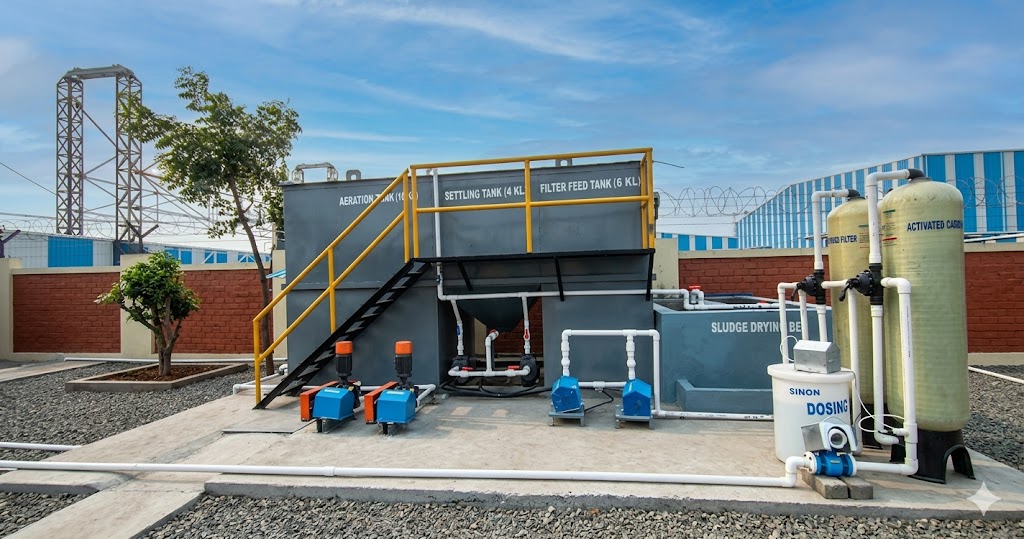
Industries generate wastewater that contains harmful chemicals, suspended solids, oil & grease, heavy metals, and toxic pollutants. If discharged untreated, this wastewater contaminates soil, ground water, lakes, rivers, and public drainage systems, leading to major environmental and regulatory risks. An Effluent Treatment Plant (ETP) is a specialized wastewater treatment system designed to remove contaminants from industrial wastewater and convert it into environmentally safe water. ETPs ensure that the treated water meets the discharge norms set by the Central Pollution Control Board (CPCB) and respective State Pollution Control Boards (SPCB). At SK Enviro Solutions, we design and manufacture customized ETP plants for industries across India using advanced technologies like Primary / Secondary / Tertiary Treatment, MBBR, MBR, SBR, and ZLD technology, depending on the effluent characteristics.
1. What is an ETP Plant?
An Effluent Treatment Plant (ETP) is a specialized water treatment system used to treat wastewater produced by industries before it is discharged into the environment. Industrial wastewater contains hazardous chemicals, oils, toxic substances, heavy metals, suspended solids, dyes, and other contaminants that can harm soil, groundwater, and aquatic life if released untreated. An ETP removes these harmful pollutants using physical, chemical, and biological processes, ensuring the treated water meets the discharge norms set by: CPCB (Central Pollution Control Board – India) SPCB (State Pollution Control Boards) Local environmental compliance regulations
2.Why Do Industries Generate Effluent?
Industries need Effluent Treatment Plants (ETP) to safely treat wastewater generated during manufacturing processes. Industrial effluent contains harmful chemicals, oils, heavy metals, toxins, and suspended solids that can severely pollute rivers, soil, and groundwater if released untreated. An ETP removes these contaminants through physical, chemical, and biological treatment, ensuring the discharged water meets CPCB and Pollution Control Board norms. By installing an ETP, industries avoid legal penalties, protect the environment, reduce freshwater consumption, and reuse treated water, making operations more sustainable and cost-efficient. Every industry uses water for cleaning, cooling, processing, chemical reactions, plating, rinsing, or manufacturing. The leftover water becomes effluent (liquid waste) which is contaminated with chemicals or pollutants specific to that industry. Examples: Textile and dyeing plant wastewater contains dyes, color, chemicals. Pharmaceutical effluent contains toxic compounds and solvents. Automobile & metal industries generate oily and greasy wastewater. Food & beverage units generate organic wastewater high in BOD/COD.
“Smart water treatment is not just technology — it’s our commitment to a cleaner, greener future.”
3. Process Flow of an ETP Plant (How it Works)
The flow of an ETP plant begins with the collection of industrial wastewater in an equalization tank, where the effluent is balanced for uniform flow and pH levels. Next, the water passes through the primary treatment stage, where processes like coagulation, flocculation, and settling remove suspended solids, oil, and grease. In the secondary biological treatment stage, microorganisms break down organic pollutants and reduce BOD/COD levels using technologies like MBBR, MBR, or SBR. Finally, in the tertiary treatment stage, advanced filtration systems, activated carbon, and disinfection remove remaining impurities, color, odor, and pathogens. The resulting water becomes clean and safe for reuse or discharge, while sludge from the process is dewatered and disposed of properly. This structured flow ensures efficiency, environmental compliance, and maximum recovery of treated wat
SK Enviro continues to lead with innovations that not only treat wastewater but transform it into a resource. The future is smart, sustainable, and efficient — and we’re building it today.
3. Technology used by sk enviro
The flow of an ETP plant begins with the collection of industrial wastewater in an equalization tank, where the effluent is balanced for uniform flow and pH levels. Next, the water passes through the primary treatment stage, where processes like coagulation, flocculation, and settling remove suspended solids, oil, and grease. In the secondary biological treatment stage, microorganisms break down organic pollutants and reduce BOD/COD levels using technologies like MBBR, MBR, or SBR. Finally, in the tertiary treatment stage, advanced filtration systems, activated carbon, and disinfection remove remaining impurities, color, odor, and pathogens. The resulting water becomes clean and safe for reuse or discharge, while sludge from the process is dewatered and disposed of properly. This structured flow ensures efficiency, environmental compliance, and maximum recovery of treated wat
At SK Enviro Solutions, we use advanced and proven wastewater treatment technologies to ensure maximum efficiency, minimal energy consumption, and long-term reliability of STP and ETP plants. Our core technologies include MBBR (Moving Bed Biofilm Reactor), MBR (Membrane Bioreactor), SBR (Sequencing Batch Reactor), and ZLD (Zero Liquid Discharge). Each technology is selected based on project requirements such as space availability, effluent characteristics, and treated water usage. MBBR offers simple and robust biological treatment, MBR provides ultra-filtration for high-quality reusable water, SBR optimizes the treatment cycle in a batch process, and ZLD ensures complete recovery of water with zero discharge. By integrating automation, smart sensors, and remote monitoring capabilities, we deliver customized, scalable, and cost-efficient treatment systems that meet CPCB / PCB compliance and support sustainable water management for residential, commercial, and industrial applications across India.
